

As inference grows, data centers located closer to customers are becoming crucial for delivering low-latency, high-efficiency processing to end users.
AI Training vs. Inference and Its Implications for Global Data Center Infrastructure
Introduction
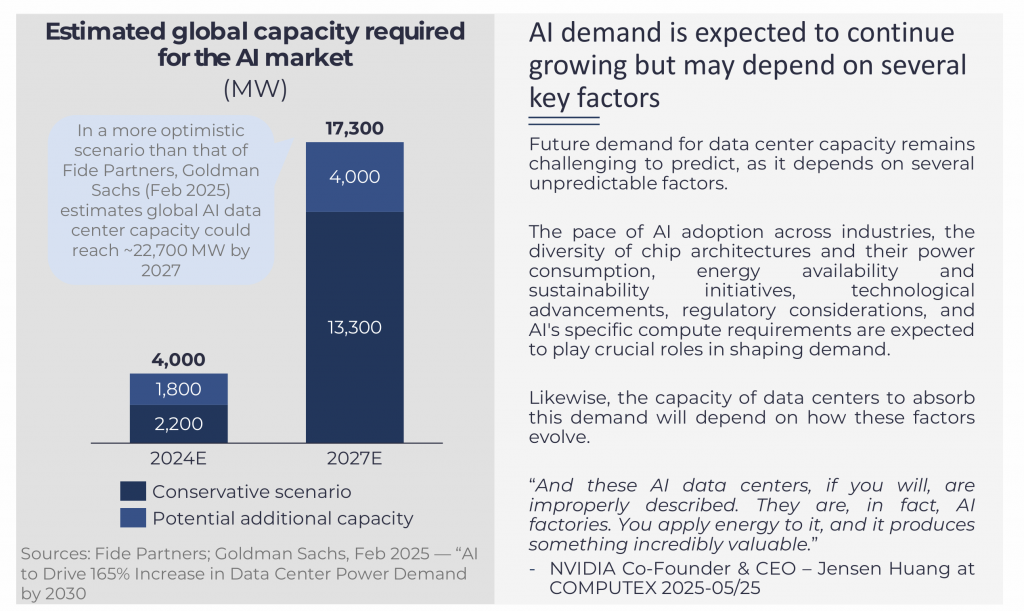
The data center market has experienced accelerating growth in recent years, driven by the rapid evolution of AI technology, increasing demand for higher data consumption, growing demand for cloud services, internet penetration, 5G consolidation, and digitalisation trends across industries.
This surge has led to substantial investments in new data center construction and facility upgrades in major markets worldwide. The rapid penetration of AI in many applications is expected to accelerate this demand further, as AI-driven applications require greater computational power and infrastructure scalability.
The emergence of new AI models, such as DeepSeek in late 2024, has marked a potential inflexion point on how industries could leverage its possible use cases at a lower cost and processing needs.
AI training and inference are the primary drivers of this increasing AI-driven demand, sparking debates about the power consumption associated with each and how the data center market will adapt to meet these needs.
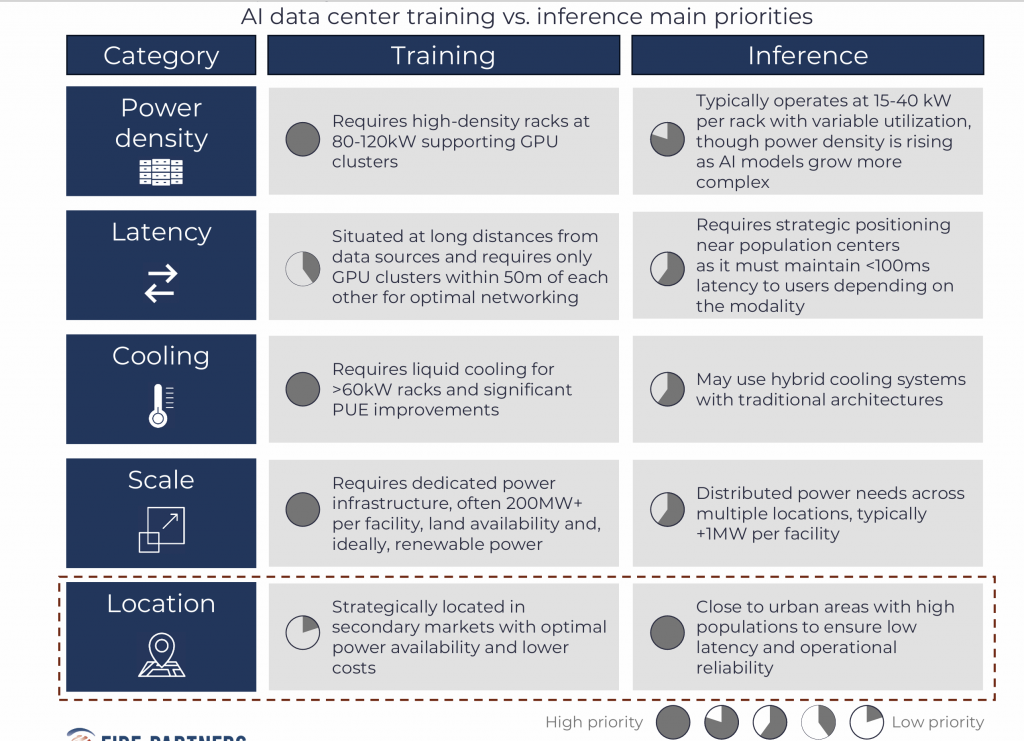
As demand for AI workloads continues to grow, the distinction between locations and facilities based on whether they support AI training or inference will be a key factor in market development. Due to latency requirements and cost control considerations, AI inference for some use cases is expected to be delivered near customers, while AI training may have greater flexibility in site selection.
AI training involves feeding a machine learning model large datasets and adjusting its parameters to minimize error. While traditional approaches rely on labeled data, advancements in self-supervised learning, particularly with transformer-based Neural Networks, enable models to learn from unstructured data by creating auxiliary tasks that uncover inherent patterns. AI training is characterized by more complex and computationally intensive processes, which require massive processing power, typically using GPUs, TPUs or AI accelerators, as large-scale data processing is required.
AI inference is the process of using a trained AI model to make predictions on new data. It is less computationally demanding than training, requiring fewer resources, but it still benefits from optimized hardware. AI inference often requires low latency, especially in applications such as real-time recommendations across many applications.
AI Training vs. Inference: A Technical Breakdown
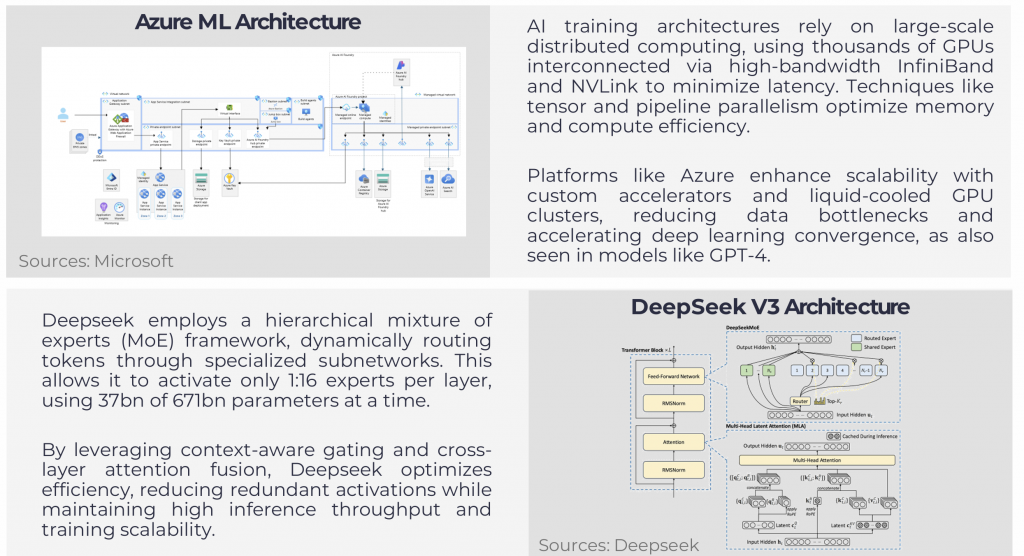
AI models process data through two main approaches: full-scale training and inference-based adaptation, each with distinct computational and cost requirements. Training a large AI model like GPT-4 has historically required around 25,000 NVIDIA A100 GPUs, consuming 50 MW and over 100 days for a single cluster. However, more recent deployments, such as xAI’s Grok, are reportedly using GPU clusters exceeding 100,000 units. These setups demand high-density racks (80–120 kW per rack), liquid cooling, and high-speed interconnects like InfiniBand or NVLink. Total training costs can exceed several hundred million dollars, driven by infrastructure, energy, and GPU hardware, typically priced at USD 20,000–USD 40,000 per unit. This type of AI training is commonly conducted in hyperscale data centers operated by Google, AWS, Microsoft and Meta. For example, Meta is projected to deploy 1.3 million GPUs by 2025, with spending plans reaching up to USD 65 billion. Increasingly, specialized GPU-as-a-Service providers such as CoreWeave and Lambda Labs are emerging as scalable alternatives for training and fine-tuning AI models, making AI technology available for smaller focused models created by new entrants.
AI inference typically operates with lower hardware and power needs. Deployments like DeepSeek, Mistral and LLaMA rely on pre-trained models that currently operate efficiently with approximately 2,000 NVIDIA H800 GPUs, typically in a 15–40 kW per rack setup. As the market shifts toward next-generation Blackwell GPUs (B100/B200), inference performance is expected to improve further while maintaining manageable power envelopes. This enables flexibility in colocation and edge data centers where efficiency and latency matter. Inference instance costs range from millions to tens of millions of dollars. Techniques like Retrieval-Augmented Generation (RAG) and Parameter-Efficient Fine-Tuning (PEFT) enable adaptation without costly retraining.
Key use cases for AI training include large language model (LLM) development, where massive datasets are used to understand, generate and process human language. Other examples include medical imaging and drug discovery, which depend on AI models to analyze datasets for disease detection and pharmaceutical research. There are also national security agencies that use AI training for large-scale simulations, handling massive datasets to predict complex scenarios.
AI inference, on the other hand, is widely used in real-time applications like customer service chatbots and virtual assistants, where models handle conversations efficiently without massive GPU clusters. For example, inference could be widely used in healthcare diagnosis for AI-assisted radiology to detect diseases in X-rays, CT scans and MRIs. In finance, fraud detection systems could analyze transaction patterns in real time. E-commerce and streaming platforms use AI inference for personalized recommendations, optimizing user experiences dynamically.
AI Training and Inference is Expected to Drive Demand Across Data Centers of All Scales
Inference is expected to drive demand for edge data centers in urban areas.
The integration of AI into data center operations is expected to require significant infrastructure adjustments to meet the distinct demands of AI training and inference. As AI positions itself globally and penetrates different industries, power density requirements are expected to increase substantially.
As of 2020, the average power density demanded was 8 kW per rack, while in 2024, power density per rack had more than doubled to 17 kW, and AI training racks are now demanding up to +100 kW per rack. These adjustments encompass enhanced computational power, optimized cooling systems, strategic data center placement, interconnection and networking, and sustainable energy practices. As inference scales, infrastructure funds are targeting Tier 2 and colocation data centers (2–5 MW) to host GPU workloads. With newer, more efficient GPUs like NVIDIA’s L4 and H100, and the upcoming Blackwell and Vera architectures, inference deployments are expected to become increasingly efficient and scalable.
Rubin architectures, edge and regional facilities can now support 15–40 kW racks suitable for real-time AI processing. These setups enable low-latency inference without requiring the scale of hyperscale data centers.
Facilities for AI training will require high-density computing infrastructure to handle large-scale data processing, leading to advanced cooling systems and sustainable energy solutions.
On the other hand, AI inference data centers are expected to prioritize low-latency, energy-efficient hardware optimized for real-time processing, often leveraging edge computing to minimize transport delays.
However, as AI models become more complex and resource-intensive, inference power density is rising. This may drive the deployment of GPUs and accelerators in edge facilities to meet low-latency demands.
The Rise of AI Inference in Urban Areas and Tier 2 and 3 Edge Markets
AI inference markets are expected to be driven by proximity to end users.
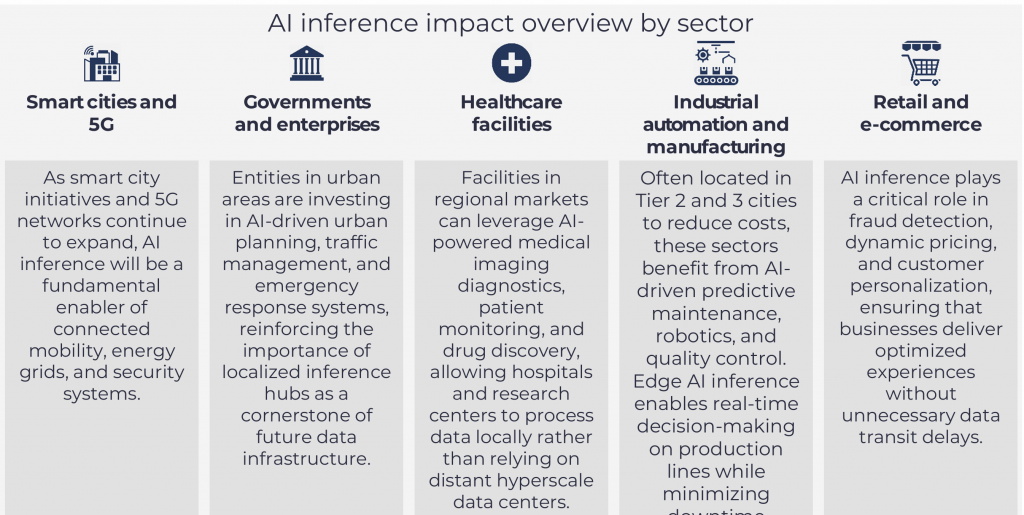
The growing demand for AI inference near urban areas is driven by the need for low-latency processing, cost efficiency, and localized AI applications. Unlike AI training, which is best suited for hyperscale data centers due to its high computational requirements, inference benefits from being closer to end users. This proximity enables real-time AI-powered services across industries where ultra-low latency is critical, such as autonomous vehicles, financial trading, and smart city infrastructure. In contrast, industries such as industrial automation and large-scale manufacturing, often located outside urban centers, benefit from edge inference processing in Tier 2 and Tier 3 markets, where AI-powered predictive maintenance and supply chain optimization enhance operational efficiency.
Deploying inference workloads in urban data centers may reduce data transport costs and network congestion by minimizing reliance on centralized hyperscale hubs. Industries such as retail, logistics, and smart infrastructure rely on real-time AI-driven decision-making, making urban inference hubs essential for optimizing customer experiences, financial transactions, and public services. However, industries that operate outside major urban areas, such as industrial manufacturing, agriculture, and remote energy facilities, benefit from inference processing at the edge in Tier 2 and Tier 3 markets, where AI-powered automation and real-time monitoring can operate independently of urban infrastructure.
This shift also aligns with sustainability goals, as inference is expected to be less power-intensive than training and can be strategically deployed in areas with renewable energy sources and lower infrastructure costs. Texas (USA), for example, is experiencing a significant surge in the data center market, driven by relatively low energy costs and a deregulated energy market, making it a strategic hub for AI infrastructure. The expansion of AI inference facilities in urban centers not only reduces the carbon footprint of AI workloads but also optimizes bandwidth usage by decreasing network congestion on primary routes.
From an infrastructure perspective, urban areas may be more expensive to scale as land is expected to have higher prices and to be scarcer. However, the availability of local computing resources ensures that inference processing can be performed closer to data generation points, minimizing delays and improving efficiency.
Additionally, network optimization and latency reduction remain key drivers of AI inference expansion in urban environments. Low-latency inference is critical for applications such as autonomous transportation, financial trading, and smart city services, where even milliseconds of delay can impact decision-making.
Ultimately, the shift toward decentralized AI inference represents more than just an operational adjustment, as it signals a fundamental transformation in how AI services are deployed. By expanding AI inference capabilities close to end users, data centers of all sizes will ensure that AI-powered applications scale efficiently, reducing network transport costs, improving sustainability, and delivering real-time intelligence where it is needed most.
AI Inference: Powering Real-Time Decision Making in Healthcare, Finance and Banking
How data centers will enable AI-driven inference in industry hubs.
Two of the most rapidly growing use cases for AI inference are in healthcare and finance, where real-time decision-making is critical. As AI adoption expands, demand for low-latency, high-efficiency inference solutions is surging in major global hubs, creating new opportunities for edge and medium-sized data centers strategically located near hospitals and financial districts.
Medical imaging is one of the most promising areas for AI inference, enabling faster and more accurate analysis of X-rays, CT scans and MRIs. AI models trained on vast datasets can assist radiologists by detecting abnormalities earlier and with greater precision, improving patient outcomes. Unlike AI training, which requires immense computational resources and hyperscale data centers, AI inference operates efficiently on smaller-scale infrastructure, making it ideal for hospitals, clinics and medical research institutions that require real-time results.
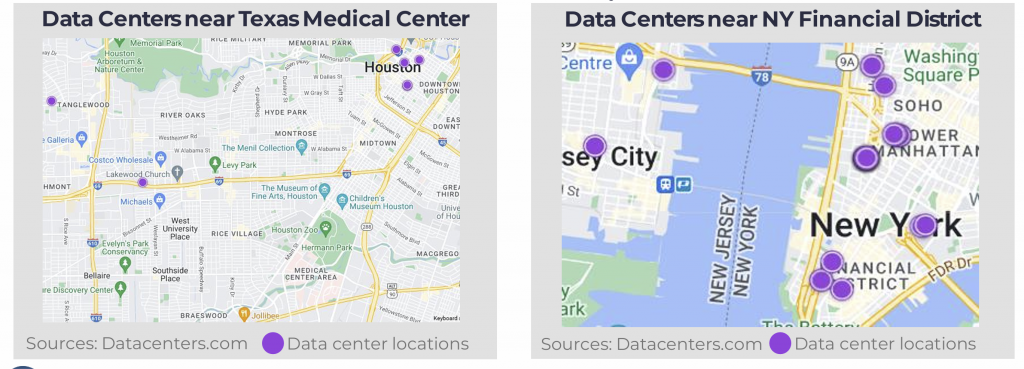
A prime example of where this technology is gaining traction is the Texas Medical Center in Houston, the world’s largest medical complex, housing more than 60 hospitals and medical institutions. Deploying AI inference solutions in edge and mid-size data centers close to this hub allows for faster processing, reduced latency, and improved integration with existing healthcare workflows. Other major medical hubs, such as Boston’s Longwood Medical Area, California’s Stanford Medicine cluster, and London’s Harley Street medical district, also present significant opportunities for AI-driven diagnostics.
As demand grows, edge and medium-sized data centers (ranging from 1 to 20 MW) are becoming critical in supporting AI inference. These facilities provide high-speed connectivity and specialized compute resources while maintaining a compact footprint compared to hyperscale data centers.
In the financial and banking sector, AI inference is revolutionizing fraud detection, cybersecurity, and risk management, where real-time decision-making can prevent billions in losses. AI models analyze vast volumes of transactional data, user behavior, and market activity in real time, enabling financial institutions to detect anomalies and prevent threats before they escalate.
While high-frequency trading (HFT) remains a notable use case, where milliseconds can define success or failure, the broader application of AI to security and compliance is becoming even more critical.
To support these workloads, edge and regional data centers near financial hubs provide the low-latency environments needed for AI-driven analysis. Rather than relying on hyperscale data centers optimized for training, financial institutions increasingly use edge and medium-sized data centers (1 to 20 MW) located near financial districts.
A key example is New York City’s Financial District, home to America’s major financial institutions. The region hosts over 190 data centers within 100 miles, 48 of them within just 2 miles. Facilities like Equinix offer 1.7 MW of IT capacity, while larger centers like Sabey support up to 18 MW. These facilities are optimized for inference tasks, reducing latency and strengthening cybersecurity and fraud detection capabilities to support faster and more secure decision-making.
As AI adoption accelerates, healthcare, finance and banking, among other industries, will continue to drive demand for distributed, high-performance AI inference solutions. Edge and medium-sized data centers near these industry hubs will play a critical role in enabling real-time AI applications, ensuring that healthcare providers can deliver faster diagnostics and financial institutions can combat fraud and optimize cybersecurity with greater efficiency.
Conclusion: The Future of AI-Driven Data Center Evolution
The rapid integration of AI into industries worldwide is reshaping the data center landscape, driving unprecedented demand for both high-performance AI training clusters and low-latency AI inference infrastructure. As AI models grow more sophisticated, the distinction between training and inference has become crucial in determining how and where computational resources are deployed.
AI training remains the domain of hyperscale data centers, requiring massive GPU clusters, high-density power consumption, and advanced cooling solutions. However, AI inference is fueling demand for edge and mid-sized data centers closer to end users, enabling real-time processing for applications in finance, healthcare, and beyond. The expansion of AI inference infrastructure in urban hubs, financial districts, medical clusters, and Tier 2 and Tier 3 edge markets underscores the need for highly connected, power-efficient, and strategically located facilities.
As AI adoption accelerates, data centers must evolve to meet these growing demands. The future of AI-driven infrastructure will depend on a balance between centralized hyperscale hubs for training and distributed edge locations for inference. This shift will redefine industry strategies, investment priorities, and the global footprint of data centers, shaping the next era of digital transformation.