
logo-fide
  • About us
  • |
  • Expertise Areas
    • —
      Strategy
    • —
      Transformation
    • —
      Due diligence and transaction support
    • —
      Public sector policy and regulatory support
    • —
      Expert witness and legal support
  • |
  • Projects
  • |
  • Insights
  • |
  • Team
  • |
  • Careers
  • |
  • Contact
  • Spanish

Share:

Published 8 Feb at 12:11 am

The Great Decoupling – The strategic rise of DC secondary markets

Data Centres & Cloud
Tom Allegaert: tom.allegaert@fidepartners.com
Felipe Sarmiento: felipe.sarmiento@fidepartners.com
Nicolás Meneses: nicolas.meneses@fidepartners.com

Why power scarcity is rewriting the data centre deployment map

The long-standing link between economic density (enterprises, users, activity) and digital infrastructure is beginning to break apart.

For years, data centre site selection followed an almost unquestioned rule: build where the users and business hubs are. But as power scarcity tightens across primary markets, this once reliable logic is fading, especially for large-scale compute.

What we are now seeing is a structural unbundling of workloads. Latency-sensitive applications must stay rooted in saturated Tier-1 hubs, yet the fast-expanding universe of power-intensive AI and data-processing demand is being pushed to migrate.

Investment is therefore gravitating toward a new market category: one defined less by sheer population or economic gravity, and more by the arbitrage of scalable power, optimised Total Cost of Ownership (TCO), and continental or intercontinental connectivity.

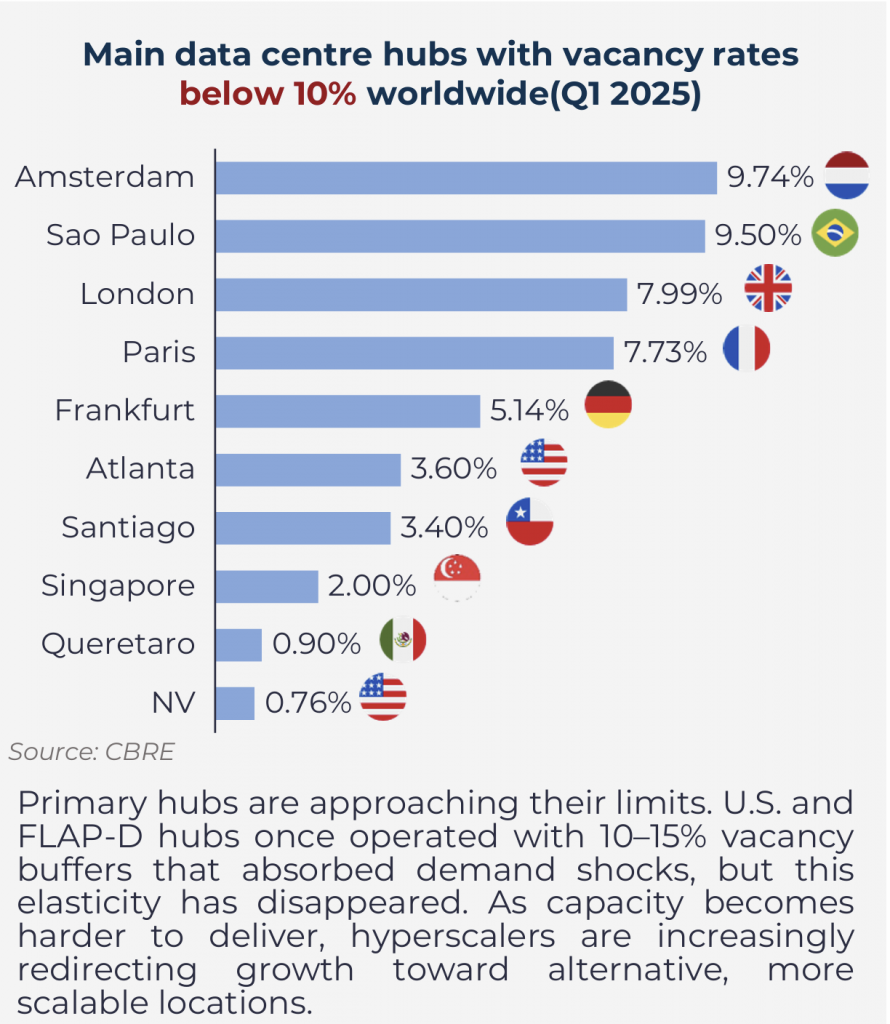
This shift is not a simple case of “spillover”. It represents a conscious geographic reordering. As vacancy in North America and FLAP-D contracts trend to near-zero, the industry is turning to secondary nodes — from the Nordics to Southern Europe and Latin America — that still offer the rare combination of available power, regulatory flexibility, and long-term scalability.

What is driving the industry toward these specific secondary markets?

There has been a surge in announcements and large-scale data centre projects in secondary and new markets. These projects are often designed to serve demand that extends far beyond the local area. The question is: What is guiding hyperscalers and DC developers toward these locations? The following paragraphs introduce the dynamics shaping this shift.

The depreciation trap: How the TCO is reshaping the capacity geography

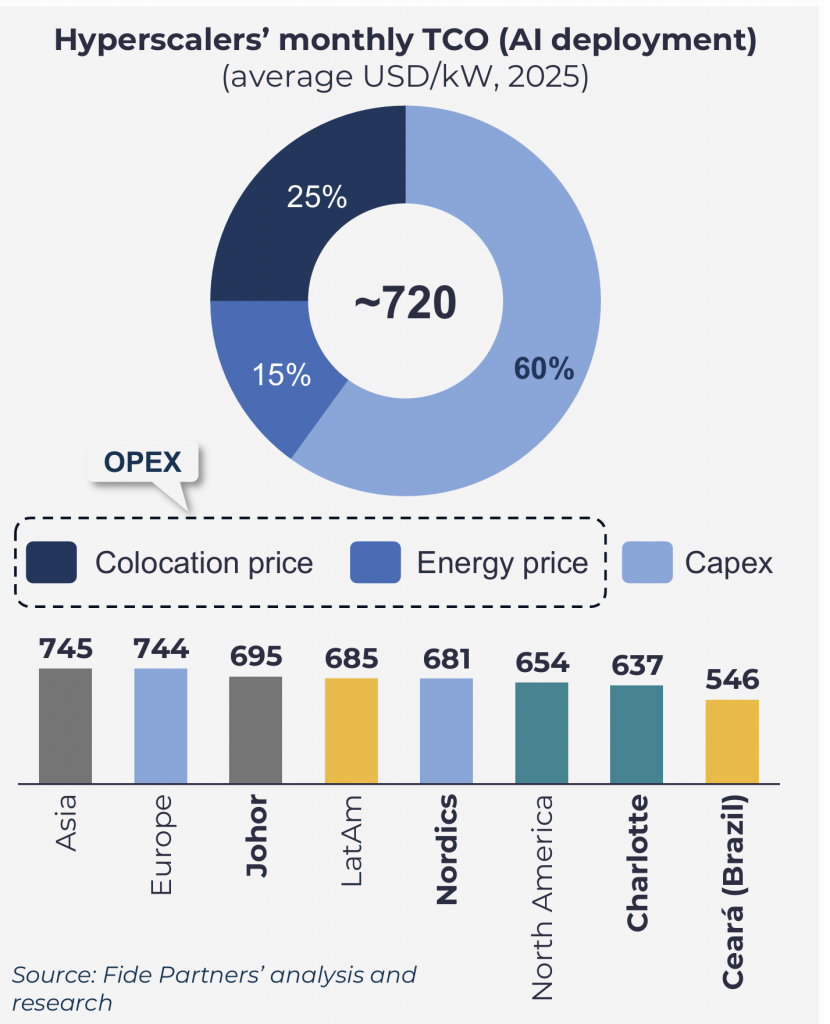
For hyperscalers, the economics of AI have introduced a brutal new variable: rapid hardware depreciation.

Unlike traditional infrastructure, where assets amortise over potentially decades, AI clusters rely on GPUs that cost hundreds of thousands of dollars but have 3- to 6-year obsolescence cycles.

This creates a “depreciation trap”. When recurring capex for server refreshes is this high, often dominating the TCO, the tolerance for inefficient opex diminishes. Operators simply cannot afford to pay premium power prices or punitive import duties (which can reach 40% of hardware costs) on top of massive, recurring hardware outlays.

Consequently, the market is shifting toward jurisdictions that can actively mitigate the cost basis through two mechanisms:

  1. Fiscal arbitrage: regions offering Free Trade Zone (FTZ) frameworks or fiscal exemptions that effectively subsidise the rapid refresh cycle.
  2. Energy arbitrage: markets with abundant and cheap renewable generation can decouple operating costs from the volatility of global energy markets.

For an industry that needs to replace its core assets every few years, these less saturated jurisdictions are where the depreciation curve and the power bill can coexist.
The geometry of latency: Strategic positioning in a connected world
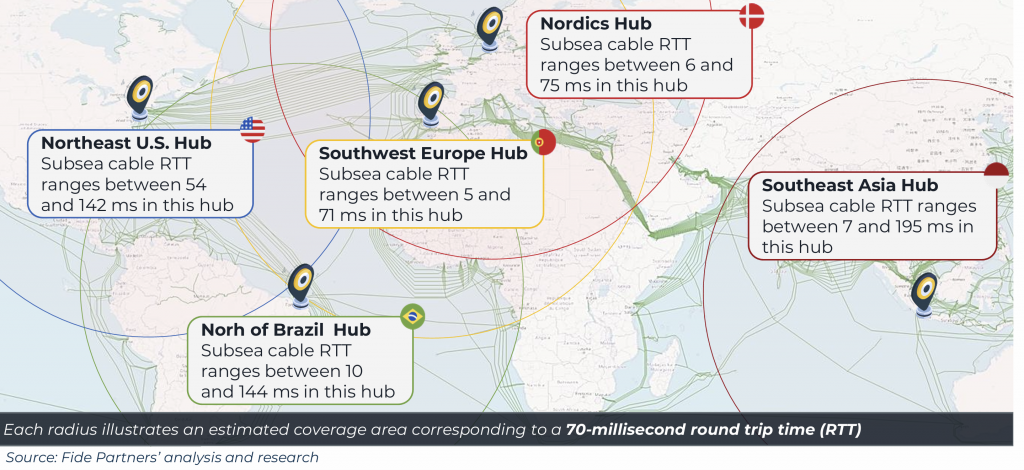
Secondary hubs can function as alternatives to Tier-1 locations when dense subsea ecosystems provide direct, diversified paths to major demand centres.

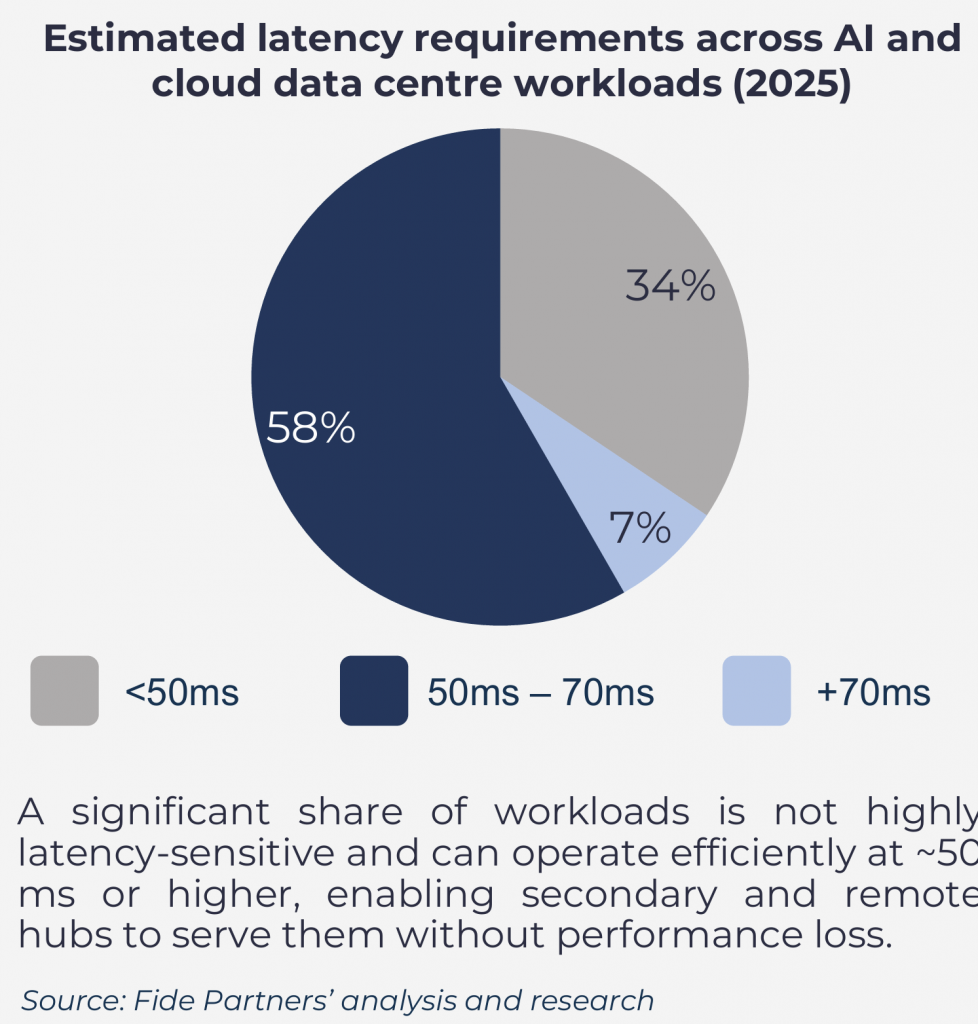
An important shift is that not all workloads require ultra-low latency. Nearly 60% of today’s IT demand, including AI inference and business applications, operates effectively within moderate Round Trip Time (RTT) ranges of 50–70 ms. This “tolerance window” is enabling deployment in new geographies.

Examples like Sines in Portugal illustrate this dynamic: Microsoft’s upcoming build-out will leverage new transatlantic systems delivering sub-70 ms connectivity to North America, Latin America, and Africa.

In Ceará, Brazil, TikTok is capitalising on one of the world’s most concentrated cable-landing clusters, achieving RTTs below ~90 ms across multiple continents.

By aligning connectivity density, route diversity, and latency thresholds, these hubs are capturing workloads that once defaulted to saturated primary markets, expanding the strategic map of where global compute can be deployed.

Where will the next winners of the digital infrastructure race emerge?

As digital demand continues to accelerate, TCO and connectivity have become two relevant forces actively reshaping hyperscale deployment logic. Power availability remains essential, but it no longer defines competitiveness on its own. Markets are rising in relevance when lower TCO, supported by fiscal incentives, FTZ frameworks, and renewable energy advantages, intersects with continental connectivity reach that enables the efficient servicing of workloads to important regions, even when these are not geographically adjacent.

This convergence is already visible in regions where new cable landings amplify the impact of supportive policy. The upcoming Chile–Pacific connectivity corridor, for example, shows how a strategically positioned system might unlock intercontinental relevance when paired with competitive cost structures and pro-investment regimes. Similar dynamics are emerging across other markets that combine modern routes with hyperscaler-friendly economics, positioning themselves as credible alternatives for distributing global IT demand.

For operators, investors, and policymakers, the challenge is not only to identify where these dynamics are intensifying, but to act before the market fully internalizes their impact. The questions are who will recognize these inflexion points early and who will discover too late that the next major hub has taken shape in a place they once considered peripheral.

DOWNLOAD PDF
5G monetisation gap
AI bubble and impact on the digital infrastructure space

Last posts

AI bubble and impact on the digital infrastructure space

3 months ago

5G monetisation gap

5 months ago

Implications of AI for DC demand and location

10 months ago

Transforming in-building wireless connectivity: the rise of software-based models

1 year ago

Impact of Generative AI on the Public and Private Cloud

1 year ago
Bogota

Carrera 11a # 98-50

Punto99, Office 704 – P.C. 110221

Bogota, Colombia

+57 601 5316741

Boston

50 Milk Street,

15th floor, P.C. 02109.

Boston, MA

London

Suite 334 – 335, Temple Chambers
3 – 7 Temple Avenue
London EC4Y 0HP
London, United Kingdom

+44 2038 187213

Madrid

C. Don Ramón de la Cruz 6,

First Floor, P.C. 28001.

Madrid, Spain

+34 910 244 113

For recruiting: hr@fidepartners.com

For business inquiries: info@fidepartners.com

Fide Partners – All rights reserved


Privacy and Cookies Policy  –GDPR

Carbon Reduction Plan 2025– Diversity, Equity and Inclusion policy + Modern Slavery Statement – Environmental policy

Your browser does not support the video tag.
Este sitio web utiliza cookies propias y de terceros para recabar información sobre usted, su navegación y su comportamiento en el sitio web, todo ello con finalidad analítica. Puede obtener más detalles sobre nuestra Política de Cookies y acceder a su panel de configuración (incluyendo la posibilidad de rechazar en bloque su instalación).